TRAVINTO / TECHNOLOGY LANDSCAPE
Understand the pattern.
Choose technology with purpose.
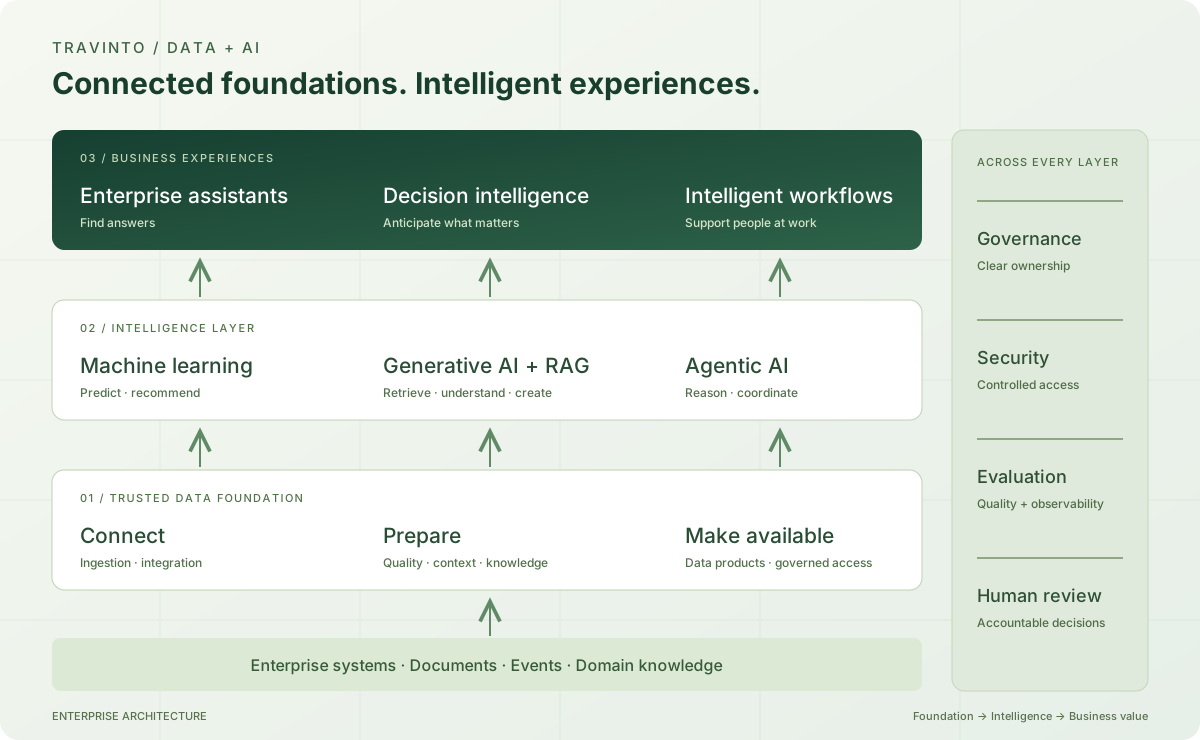
Explore the architecture responsibilities behind data platforms, AI, Agentic AI, cloud foundations, and emerging operational intelligence.
BEGIN WITH A DESIGN QUESTION
The problem should
lead the technology choice.
Does the decision need fresher events?
Compare freshness, event ordering, replay, and operating ownership.
Explore the architecture guide ↗Do answers need approved source evidence?
Explore knowledge preparation, retrieval, citations, and permission boundaries.
Explore the architecture guide ↗Does a task need tools and state?
Explore bounded orchestration, tool contracts, approvals, and recovery.
Explore the architecture guide ↗How will the experience keep working?
Explore versioning, evaluation, observability, and release controls.
Explore the architecture guide ↗16 CONNECTED ARCHITECTURE GUIDES
Explore the responsibilities.
Then compare the options.
The tools named in guides are examples, not claims of partnership, certification, or confirmed integrations.
DATA
DATA
Data lakehouse & open tables
Bring analytical and AI workloads onto a governed data foundation.
Explore detailsDATA
Real-time data & streaming
Respond to events as the business changes.
Explore detailsDATA
Data products & semantic architecture
Make enterprise information understandable and reusable.
Explore detailsAI
AI
Generative & multimodal AI
Work with enterprise text, documents, images, and audio.
Explore detailsAI
RAG, vector search & knowledge graphs
Ground AI responses in information your organization trusts.
Explore detailsAI
MLOps, LLMOps & agent evaluation
Operate AI with evidence rather than intuition.
Explore detailsAI
Intelligent document processing
Turn unstructured records into reviewable information.
Explore detailsAI
Forecasting & decision optimization
Connect predictions to practical operating choices.
Explore detailsAGENTIC AI
FOUNDATIONS
FOUNDATIONS
AI governance & security
Set boundaries for how intelligence uses enterprise information.
Explore detailsFOUNDATIONS
Cloud-native platforms & platform engineering
Create consistent foundations for enterprise delivery.
Explore detailsFOUNDATIONS
Zero trust & cybersecurity analytics
Connect identity, signals, and investigation workflows.
Explore detailsEMERGING
EMERGING
Computer vision & edge AI
Bring intelligence closer to operational signals.
Explore detailsEMERGING
Digital twins & physical AI
Explore operational scenarios before changing the physical world.
Explore detailsEMERGING
Synthetic data & privacy engineering
Explore useful test data with explicit privacy evaluation.
Explore detailsTechnology examples describe architectural options, not partner relationships, certifications, or guaranteed integrations. Selection depends on requirements and validation.
QUESTIONS CUSTOMERS BRING
Ask about fit.
Plan for operation.
Should we adopt every emerging technology?
No. Compare a proposed pattern with the simplest approach that meets the task. Data readiness, access requirements, team capability, evaluation, and operating cost may matter more than adding another component.
How should we compare vendors or platforms?
Agree workload requirements and representative tests first. Evaluate compatibility, data handling, security, quality, latency, cost, recovery, and the skills needed to operate the solution.
How do these guides connect to industry solutions?
The guides explain reusable responsibilities. Industry pages show how domain records, definitions, and professional review change the architecture. Use both views when defining a practical scope.
A USEFUL NEXT STEP
Make an architecture decision.
With evidence behind it.
Discuss the workload, current platform, constraints, and decision that the technology choice needs to support.
Discuss your priorities ↗