SQL & stored logic
Oracle PL/SQL or Teradata SQL → reviewed target SQL patterns
Review functions, types, joins, procedural flow, and transaction behavior. Agree target engine versions and validate representative business outputs.
TRAVINTO / X2X CODE CONVERTER
Assess legacy SQL, ETL, BI expressions, application code, and automation in one modernization journey. Use deterministic mappings for defined patterns and agentic assistance for ambiguous logic, with tests and engineering acceptance throughout.
ASSET / FINANCE_TRANSFORM.SQL
SELECT NVL(amount, 0)
FROM finance_events;SELECT COALESCE(amount, 0)
FROM finance_events;Check numeric types, null behavior, and business outputs in the target environment.
X2X CODE CONVERTER / MODERNIZATION WORKLOADS
Conversion starts by understanding what an asset does, what it depends on, and how its behavior will be accepted. The target patterns below are options to assess, not a universal compatibility matrix.
Oracle PL/SQL or Teradata SQL → reviewed target SQL patterns
Review functions, types, joins, procedural flow, and transaction behavior. Agree target engine versions and validate representative business outputs.
PowerCenter, DataStage or SSIS → proposed SQL, dbt or Spark workflows
Start from permitted exports and dependency metadata. Reconstruct transformations, schedules, parameters, rejects, and recovery behavior before engineering acceptance.
Legacy report expressions → a reviewed target semantic design
Assess measures, dimensions, filter context, and access rules. Use X2X BI Migrator for the broader report inventory, semantic-model, visual, and business-acceptance workstream.
COBOL, PowerBuilder or application repositories → a scoped modernization plan
Assess record layouts, interfaces, transactions, framework behavior, and build context. Target Java, .NET, Python, or other approaches only after architecture review; no universal language-to-language conversion is implied.
LEGACY SOURCE & ARTIFACT CATALOG
Search the source technology, language, or product name, then narrow by workload. Both legacy and current platforms are included because modernization scope often spans multiple generations of technology.
100 of 100 sources
No matching source. Try a broader name or choose all workloads.
Entries identify technologies and artifacts for assessment, not 100 certified automatic converters. Product versions, export formats, supported patterns, custom extensions, and source-to-target routes require confirmation.
Procedures, functions, views, SQL scripts, and schema definitions.
Exported mappings, packages, job graphs, expressions, and orchestration metadata.
Calculations, semantic definitions, queries, report expressions, and load scripts.
Authorized source repositories, libraries, copybooks, interfaces, and build definitions.
Scripts, schedules, job definitions, dependencies, and restart or failure policies.
PRODUCT FEATURES & ENGINEERING SCOPE
Scope the complete workflow, from source discovery to accepted changes. Confirm the available implementation, supported patterns, and integrations with Travinto.
Inventory permitted code, exported metadata, packages, repository versions, and build context. Classify assets by technology, complexity, criticality, and missing dependencies.
Trace calls, datasets, shared routines, schedules, parameters, and downstream consumers. Record unresolved dynamic dependencies and runtime configuration separately.
Define a reviewable representation of source operations, types, control flow, and dependencies where parsing is applicable. Retain links back to the original asset and source location.
Apply approved, versioned mappings to supported syntax and transformation patterns. Keep rule selection, unsupported constructs, and configuration traceable. Repeatability assumes the same inputs, toolchain, rules, and settings.
Use approved context to explain business intent, propose translations, and identify ambiguities. Keep confidence, evidence, and open questions visible; a generated explanation is not acceptance evidence.
Assess expressions, joins, lookups, aggregations, slowly changing dimensions, parameters, rejects, restartability, and orchestration. Propose target job structures without assuming direct feature parity.
Map metric grain, filter context, aggregations, time intelligence, security, and calculation dependencies. Validate business measures separately from visual layout or dashboard appearance.
Assess modules, APIs, transaction boundaries, framework dependencies, security controls, and external interfaces. Separate behavior-preserving code proposals from architectural redesign.
Review null handling, precision, date/time behavior, encoding, collation, ordering, error handling, and transaction semantics. Preserve domain rules through target-specific tests.
Prepare representative regression cases, expected outputs, compile or build checks, and reconciliation specifications. Runtime tests need a configured target environment and accountable reviewers.
Scope diffs, mapping explanations, dependency findings, unsupported-pattern registers, test evidence, and review comments. Confirm repository and delivery-pipeline integration before implementation.
Agree rule and model versions, access boundaries, secret handling, audit requirements, approval gates, release sequencing, and rollback responsibilities. This website does not execute code conversion or production changes.
Preserve source versions and mapping evidence. Keep unsupported constructs visible and require independent validation before accepting generated output.
TWO APPROACHES / ONE ACCEPTANCE STANDARD
Select the approach by task. Known transformations and policy checks suit explicit rules; incomplete context and complex exceptions may benefit from agent assistance.
RULES & CONTROLLED EXECUTION
CONTEXT & REVIEWABLE PROPOSALS
Approved rule execution can be repeatable for the same versioned inputs and settings. Agent-generated proposals can vary and must pass the same regression and business acceptance gates.
Versioned inputs, identity, scope
Explicit mappings or reviewed proposals
Tests, reconciliation, exception evidence
Accept, revise, reject, or escalate
Use representative cases to establish an acceptance baseline. Record input versions, rule or model configuration, failed checks, reviewer decisions, and recovery requirements.
X2X CODE CONVERTER / 10 USE CASES
Explore ten scenarios specific to X2X Code Converter. Explore a case-study card to see the business challenge, deterministic work, agentic assistance, and acceptance evidence to scope for your estate.
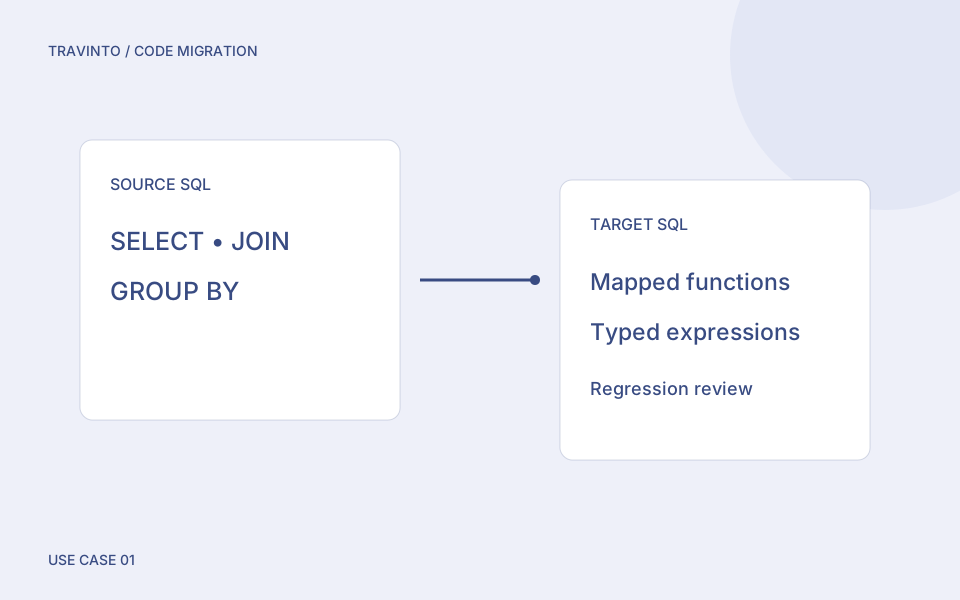 01SQL MODERNIZATIONIndustryBanking & financial servicesExample marketIndiaWarehouse SQL conversionA reporting estate is moving to a different analytical SQL engine.Explore case study
DELIVERY APPROACH & ACCEPTANCE
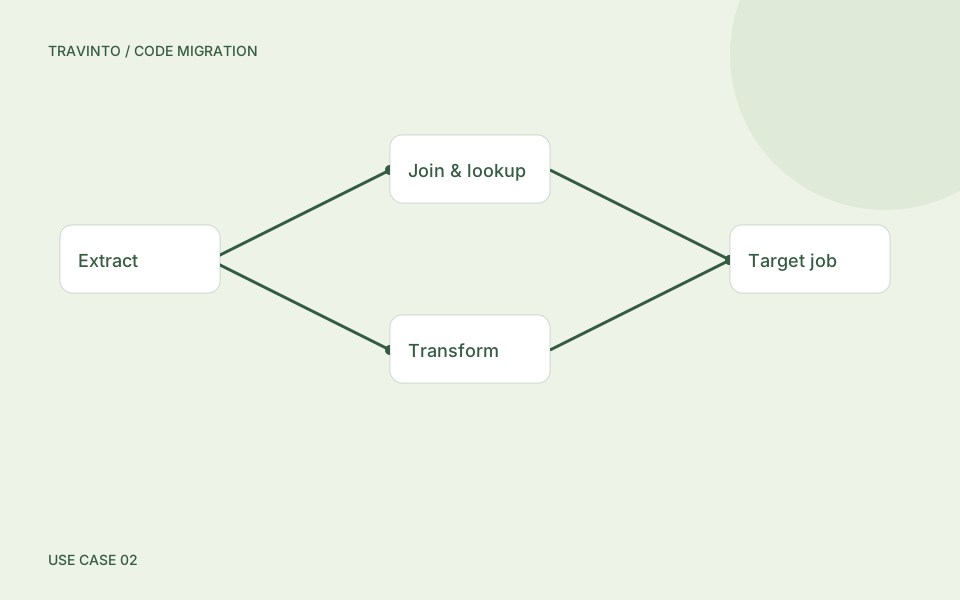 02ETL & ELTIndustryRetail & commerceExample marketUnited StatesETL mapping reconstructionTransformation logic is embedded in exported ETL mappings and job graphs.Explore case study
DELIVERY APPROACH & ACCEPTANCE
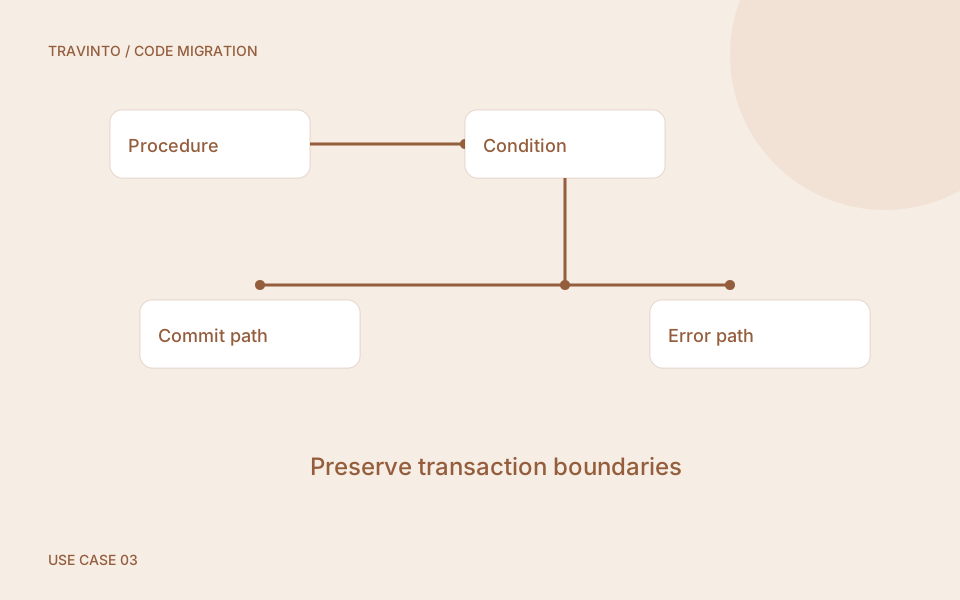 03PROCEDURAL LOGICIndustryInsuranceExample marketUnited KingdomStored-procedure modernizationBusiness rules live in procedures with transactions, cursors, temporary objects, and exception branches.Explore case study
DELIVERY APPROACH & ACCEPTANCE
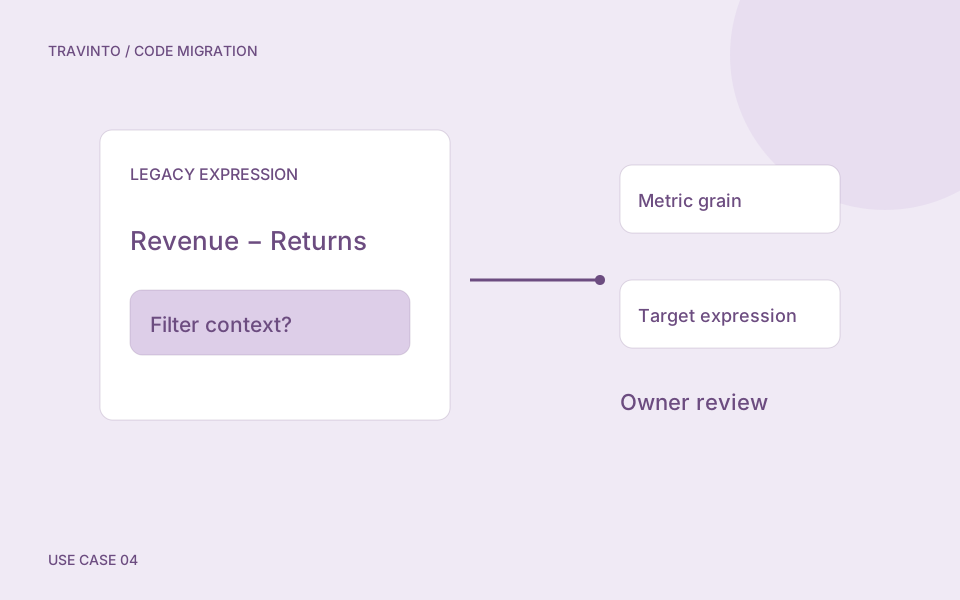 04REPORTING LOGICIndustryRetail & commerceExample marketAustraliaBI calculation code extractionA report renewal requires legacy metric expressions to be understood before redesign.Explore case study
DELIVERY APPROACH & ACCEPTANCE
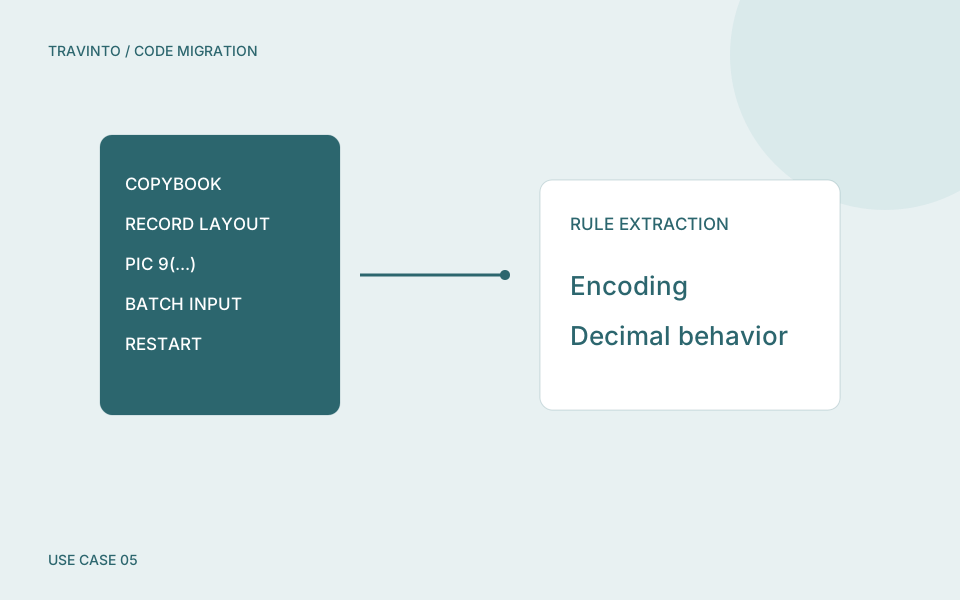 05MAINFRAMEIndustryBanking & financial servicesExample marketUnited StatesMainframe batch logic assessmentA modernization team needs to separate business logic from batch and platform assumptions.Explore case study
DELIVERY APPROACH & ACCEPTANCE
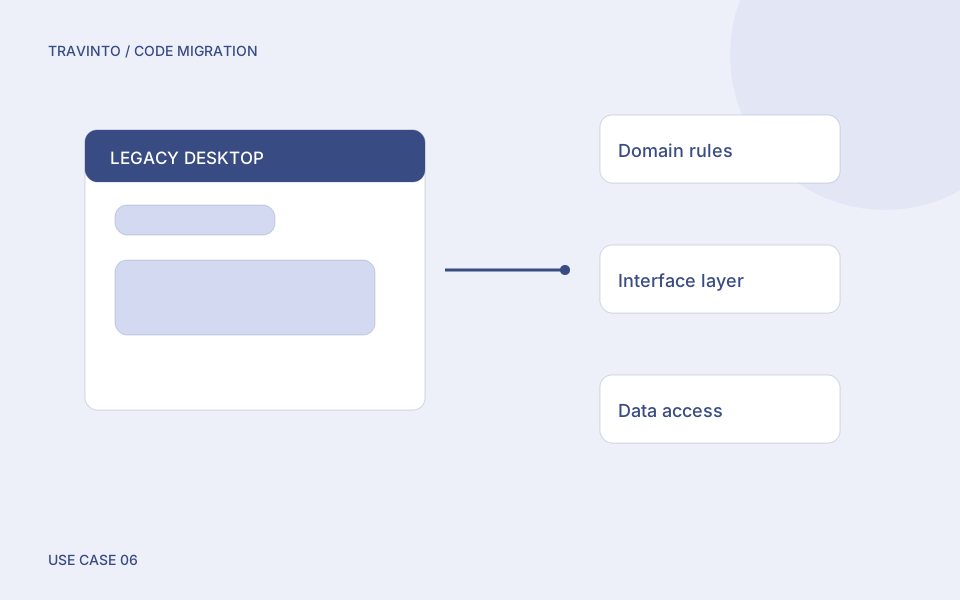 06LEGACY APPLICATIONSIndustryManufacturingExample marketGermanyPowerBuilder and Visual Basic renewalA desktop application contains valuable rules mixed with user-interface and persistence logic.Explore case study
DELIVERY APPROACH & ACCEPTANCE
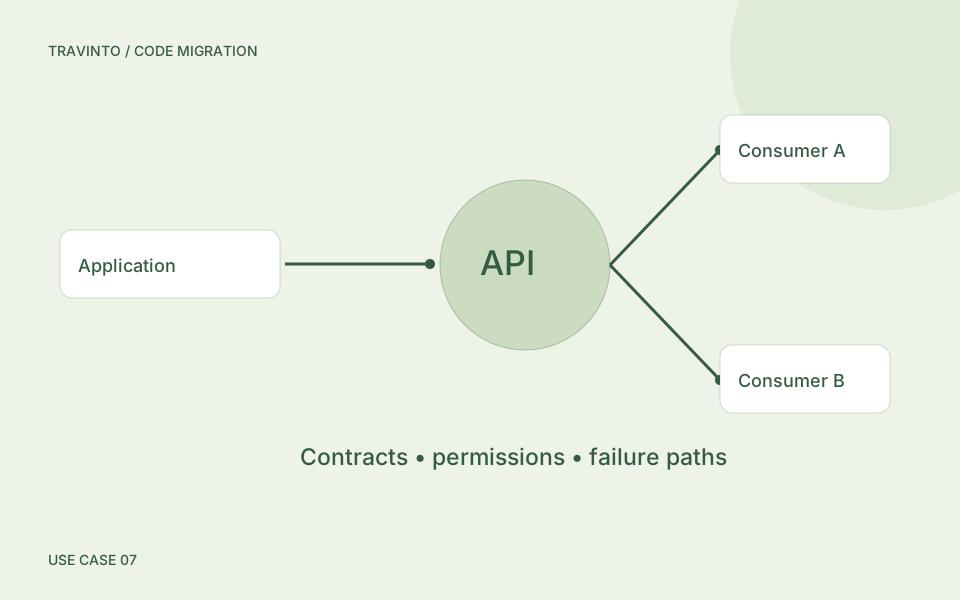 07SERVICE MODERNIZATIONIndustryTelecommunicationsExample marketSingaporeApplication API refactoringA team is extracting a bounded capability from a tightly coupled application.Explore case study
DELIVERY APPROACH & ACCEPTANCE
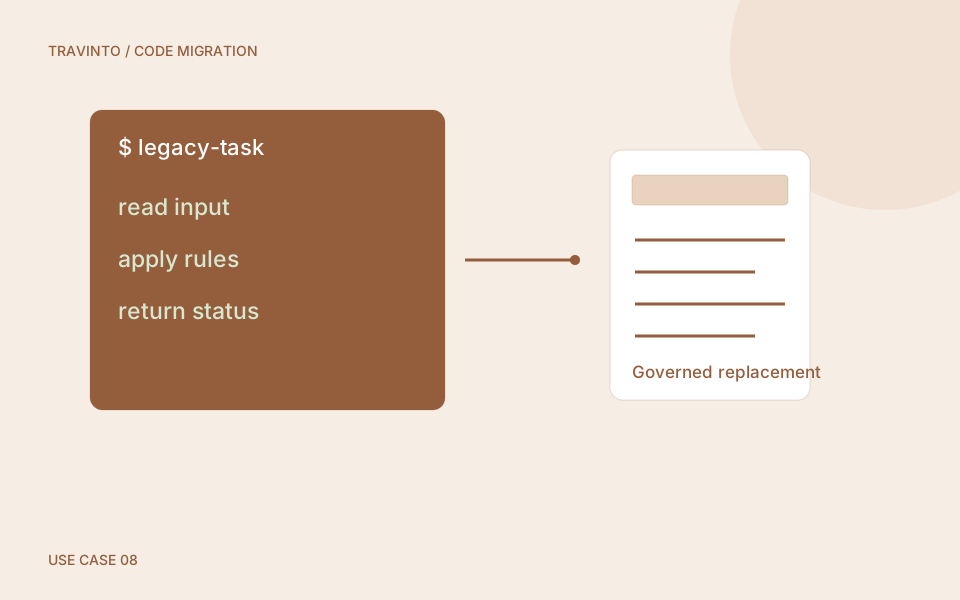 08SCRIPTINGIndustryProfessional servicesExample marketCanadaScript estate standardizationOperational logic is spread across Python, Perl, shell, and platform-specific scripts.Explore case study
DELIVERY APPROACH & ACCEPTANCE
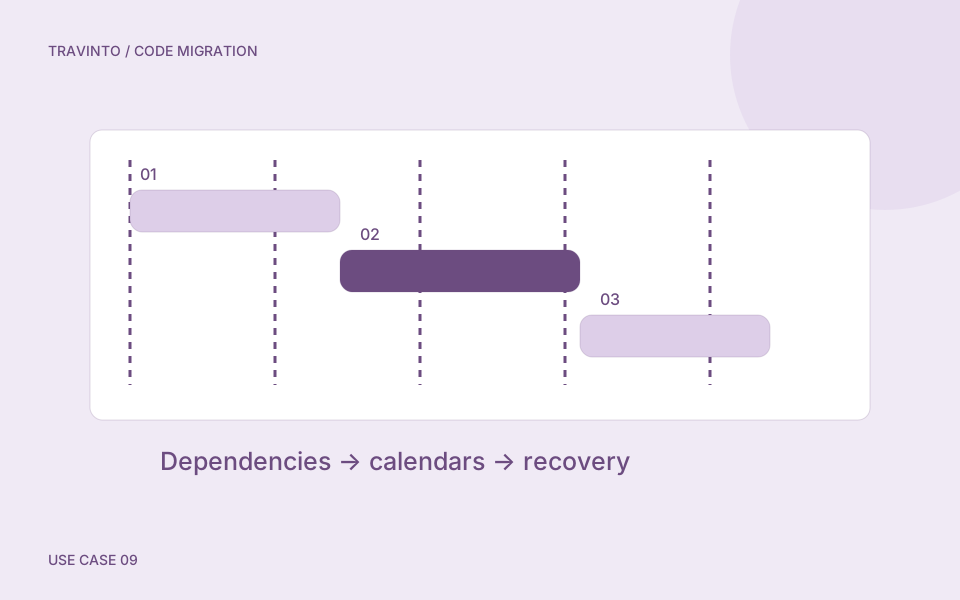 09ORCHESTRATIONIndustryLogisticsExample marketNetherlandsScheduler and job-definition conversionA platform transition changes how jobs are scheduled and recovered.Explore case study
DELIVERY APPROACH & ACCEPTANCE
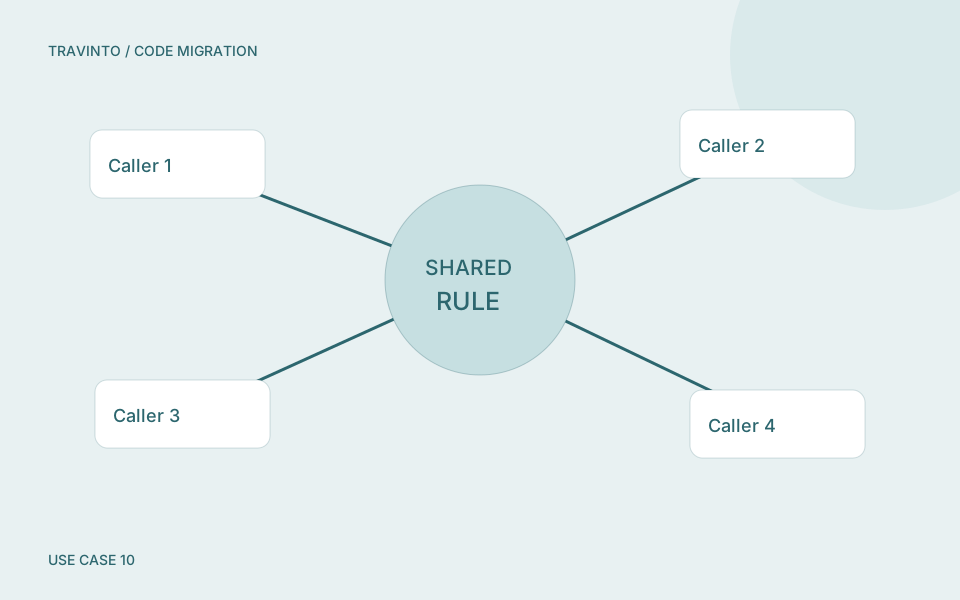 10REUSABLE LOGICIndustryInsuranceExample marketUnited Arab EmiratesShared business-rule library renewalRepeated code implements similar rules differently across an estate.Explore case study
DELIVERY APPROACH & ACCEPTANCE
Industry and example-market labels provide scenario context. They do not identify actual customers or customer locations. These use cases describe requirements and design approaches, not completed customer projects. Source and target compatibility, available features, and implementation scope are confirmed during assessment.
X2X CODE CONVERTER / 10 CASE STUDIES
Industry-led migration scenarios with a clear source, target, inventory, time window, and acceptance focus. Use the arrows, numbered controls, or swipe to browse.
 CASE 01
A reporting estate is moving to a different analytical SQL engine.
 CASE 02
Transformation logic is embedded in exported ETL mappings and job graphs.
 CASE 03
Business rules live in procedures with transactions, cursors, temporary objects, and exception branches.
CASE 04A report renewal requires legacy metric expressions to be understood before redesign.
CASE 05A modernization team needs to separate business logic from batch and platform assumptions.
 CASE 06
A desktop application contains valuable rules mixed with user-interface and persistence logic.
 CASE 07
A team is extracting a bounded capability from a tightly coupled application.
 CASE 08
Operational logic is spread across Python, Perl, shell, and platform-specific scripts.
 CASE 09
A platform transition changes how jobs are scheduled and recovered.
CASE 10Repeated code implements similar rules differently across an estate.
Industries, locations, customer-team profiles, inventory quantities, and time windows are scenario assumptions, not claims about actual clients or completed migrations. Timing follows an estimation baseline of 2 months per 1,000 migration inventory items; item complexity and delivery capacity change the actual schedule. Product compatibility and delivery schedules require assessment.
PRODUCT QUESTIONS
No universal compatibility is claimed. Source and target versions, custom functions, procedural logic, and runtime behavior need assessment. Engineers review generated code and test business equivalence before release.
Start with a bounded workflow, authorized source examples, platform versions, business rules, and named reviewers. Agree the expected evidence and acceptance criteria before implementation.
Contact Travinto with the source and target landscape, scope, and operating constraints. Availability, integrations, execution capabilities, delivery responsibilities, and commercial terms require confirmation.
The catalog contains 100 named source technologies and artifact families across SQL, ETL and ELT, BI, applications and mainframe, and automation. The list describes assessment scope rather than certified automatic conversion coverage. Confirm versions, export formats, dependencies, licensed access, and target requirements for each selected route.
They share discovery, mapping, exception review, and acceptance controls, but their semantics differ. ETL needs transformation and recovery parity; BI needs measure and filter parity; applications need runtime, transaction, interface, and security validation. Code conversion alone does not complete every modernization workstream.
Provide authorized source files or supported metadata exports, version information, dependency and build context, permitted test data, business rules, target constraints, and acceptance examples. Do not include credentials or production secrets. Availability, supported patterns, tooling integrations, and execution scope require confirmation.
Product scope and availability are confirmed during assessment. This website does not execute migrations, data pipelines, or operational actions.
Compare Travinto products