Do we need a tool for every layer?
No. This is a map of responsibilities, not a shopping list. Select patterns and services for a bounded use case, existing capabilities, access needs, and operating constraints.
TRAVINTO / THE CONNECTED ENTERPRISE LANDSCAPE
A reference view of the responsibilities connecting enterprise sources, data platforms, knowledge, models, agent workflows, and user experiences.
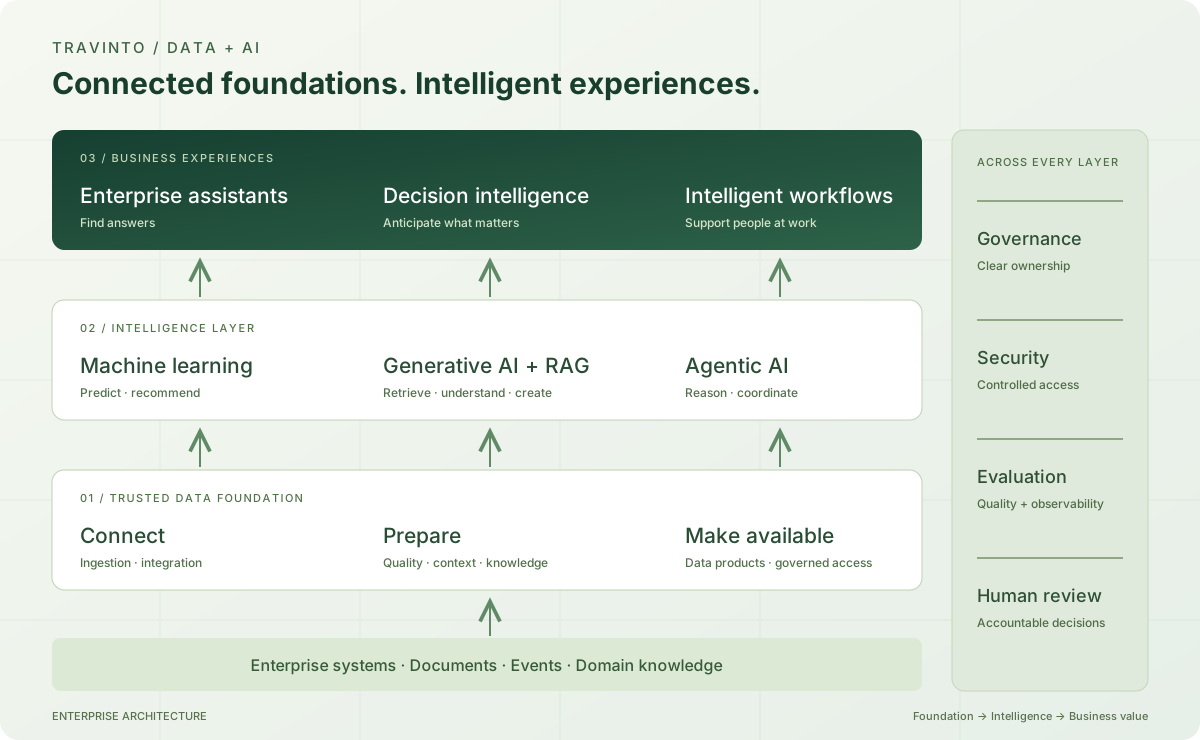
THE DECISIONS BEHIND THE ARCHITECTURE
No. This is a map of responsibilities, not a shopping list. Select patterns and services for a bounded use case, existing capabilities, access needs, and operating constraints.
A promising model output may hide unowned data, inconsistent access, missing evaluations, fragile tools, or unclear support. Trace the complete user task rather than evaluating the model alone.
Map one outcome to its sources and operating responsibilities. Identify the gap that blocks usefulness or trust, then compare a focused improvement with a larger platform change.
WORK AREAS & TYPICAL DELIVERABLES
These are engagement directions; selected responsibilities and deliverables are agreed for the problem in hand.
Define the user, task, decision, owner, and acceptance evidence before choosing the technology.
Typical output: A bounded outcome and domain vocabulary.
Connect authorized systems, events, and documents through contracts, history, quality checks, and curated products.
Typical output: A traceable data foundation and serving responsibilities.
Preserve business definitions, identity relationships, source versions, permissions, and retrieval relevance.
Typical output: A context model and evaluated knowledge access.
Select predictive or generative patterns and test task quality, grounding, failure behavior, latency, and cost.
Typical output: A model/prompt strategy and representative evaluation set.
Define permitted tool actions, workflow state, checkpoints, approval boundaries, and failure recovery.
Typical output: A bounded execution model with traceable handoffs.
Design the review queue, citations, uncertainty, feedback, monitoring, release controls, and support ownership together.
Typical output: A usable experience and an operating plan.
A CONNECTED REFERENCE VIEW
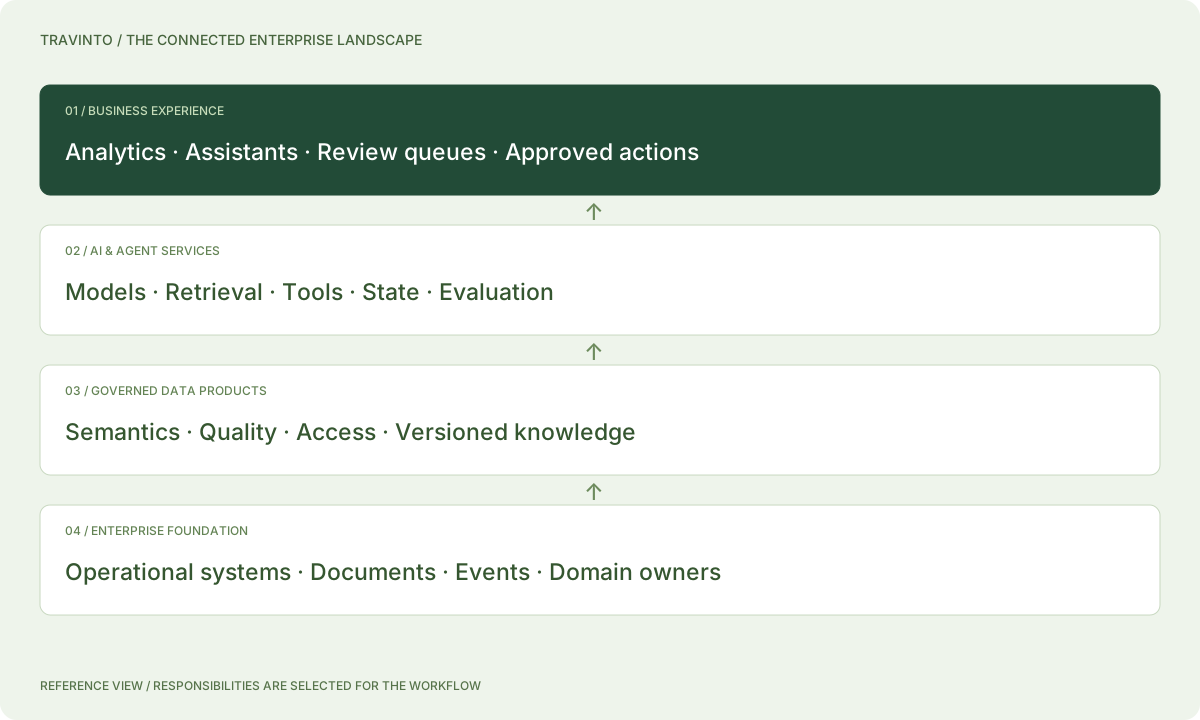
Analytics · Assistants · Review queues · Approved actions
Models · Retrieval · Tools · State · Evaluation
Semantics · Quality · Access · Versioned knowledge
Operational systems · Documents · Events · Domain owners
Logistics example / reconstruct one exception
A delayed shipment answer depends on partner identifiers, event ordering, status semantics, source freshness, approved operating knowledge, and an operator’s authority. Trace that one task across the landscape to expose the real dependencies.
Explore this industry ↗
WHAT A USEFUL ASSESSMENT CAN LEAVE BEHIND
Outcome-to-source responsibility map
Data, knowledge & tool boundaries
Dependency and ownership gaps
Evaluation & operational acceptance plan
Sequenced improvement roadmap
A USEFUL NEXT STEP
Bring a representative workflow, existing definitions or controls, permitted source examples, and the people who own the result.
Discuss your priorities ↗