Where should governance start?
Choose a bounded domain or decision with a named owner. Follow its information from source to consumer, identify failures and permissions, and agree who resolves them.
TRAVINTO / DATA & AI GOVERNANCE
Data and AI governance connecting ownership, quality, access, lineage, retention, evaluation, and human approval in everyday workflows.

THE DECISIONS BEHIND THE ARCHITECTURE
Choose a bounded domain or decision with a named owner. Follow its information from source to consumer, identify failures and permissions, and agree who resolves them.
Carry source permissions, classifications, versions, and retention rules into retrieval and model context. Add model and workflow evaluation, tool permissions, approval boundaries, and traceable decisions.
Connect policies to operating actions: a failed quality check has an owner, denied access is enforced, a lineage gap is investigated, and an exception has a scope and expiry.
WORK AREAS & TYPICAL DELIVERABLES
These are engagement directions; selected responsibilities and deliverables are agreed for the problem in hand.
Define accountable domain owners, stewards, platform operators, model/workflow owners, and approving reviewers.
Typical output: A responsibility map and issue-resolution process.
Agree fit-for-purpose checks, thresholds, exception routing, remediation ownership, and consumer communication.
Typical output: A quality rule set, issue workflow, and acceptance criteria.
Connect source authority, business meaning, transformations, classifications, and consumers. Prioritize the lineage needed to investigate a real issue.
Typical output: A discovery and lineage scope with governed definitions.
Define permitted purposes, identity scope, sharing, retention, deletion, and reviewable exceptions across source and derived information.
Typical output: An access model, lifecycle rules, and an exception register.
Test groundedness, access isolation, tool behavior, misuse, escalation, and reviewer acceptance on representative cases.
Typical output: An evaluation plan, tool permission matrix, and approval policy.
Define review cadence, escalation, training needs, operational evidence, and measures that trigger accountable action.
Typical output: An operating model, review agenda, and improvement backlog.
A CONNECTED REFERENCE VIEW
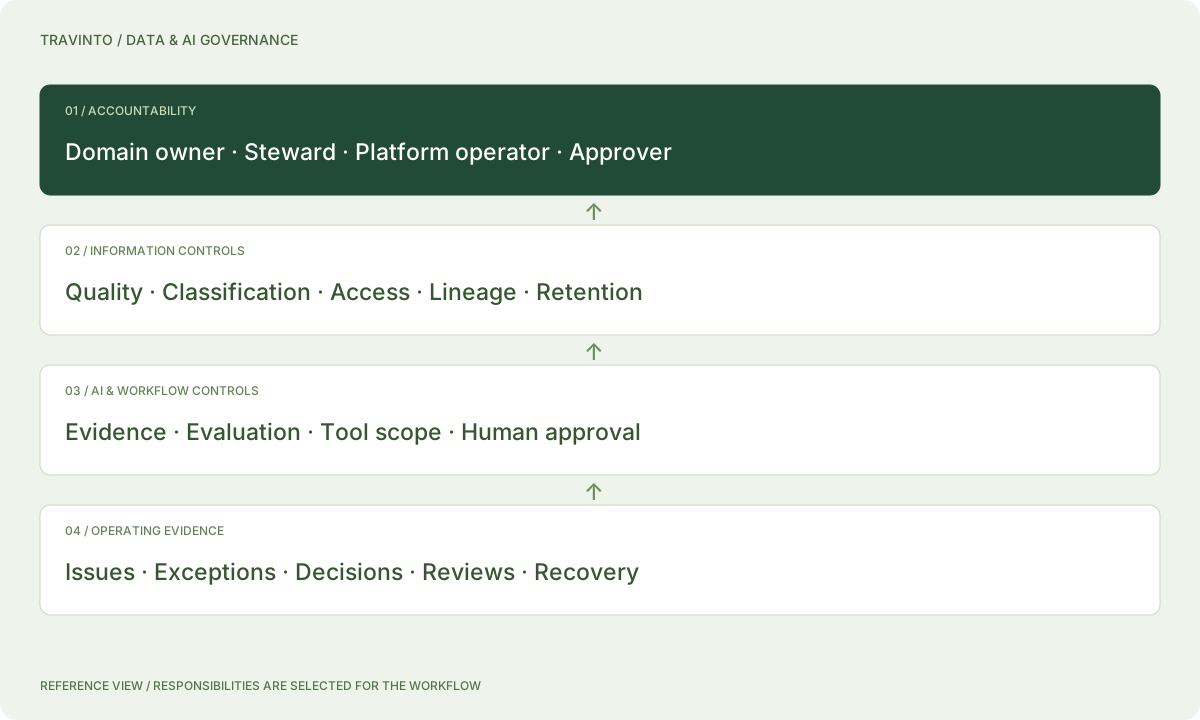
Domain owner · Steward · Platform operator · Approver
Quality · Classification · Access · Lineage · Retention
Evidence · Evaluation · Tool scope · Human approval
Issues · Exceptions · Decisions · Reviews · Recovery
Banking example / the policy has a date
A servicing answer can be wrong even when its citation is genuine: it may use the wrong product, policy period, or account context. Governance needs to preserve applicability and access, and assign who resolves a conflicting source.
Explore this industry ↗
WHAT A USEFUL ASSESSMENT CAN LEAVE BEHIND
Domain ownership & responsibility map
Quality and access control requirements
Lineage & classification priorities
AI/agent evaluation and approval rules
Issue, exception & review operating model
A USEFUL NEXT STEP
Bring a representative workflow, existing definitions or controls, permitted source examples, and the people who own the result.
Discuss your priorities ↗