Data. Intelligence. Possibility.
CareersContactsales@travinto.com
travinto.TECHNOLOGIES Let’s talk ↗

What are you looking for?

Start typing to explore Travinto.

TRAVINTO / X2X DATA MIGRATOR

Move the data.
Carry the meaning forward.

Database, warehouse, and COTS application data migration—planned around business meaning, historical records, reconciliation, and cutover. Combine deterministic execution rules with agent-assisted mapping and exception investigation.

X2X Data Migrator workspace preview with source-to-target mappings, review states, and acceptance evidence using demonstration records
Migration workspace preview · demonstration records

X2X DATA MIGRATOR / MIGRATION LANDSCAPE

Different estates.
A controlled migration path.

Choose the data and application boundary before choosing the transfer method. The routes below are assessment examples; version compatibility, connectors, and execution support are confirmed for the engagement.

Same-engine database migration

PostgreSQL → PostgreSQL · SQL Server → SQL Server

Relocation, infrastructure refresh, or a managed-database move.

Scope and validation requirements

Assess engine versions, extensions, collations, encoding, roles, large objects, backup or export methods, and the change-capture path. Separate table movement from jobs, permissions, stored code, and application connection changes.

Cross-engine database migration

Oracle Database → PostgreSQL · SQL Server → PostgreSQL

A change of database engine with explicit semantic mapping.

Scope and validation requirements

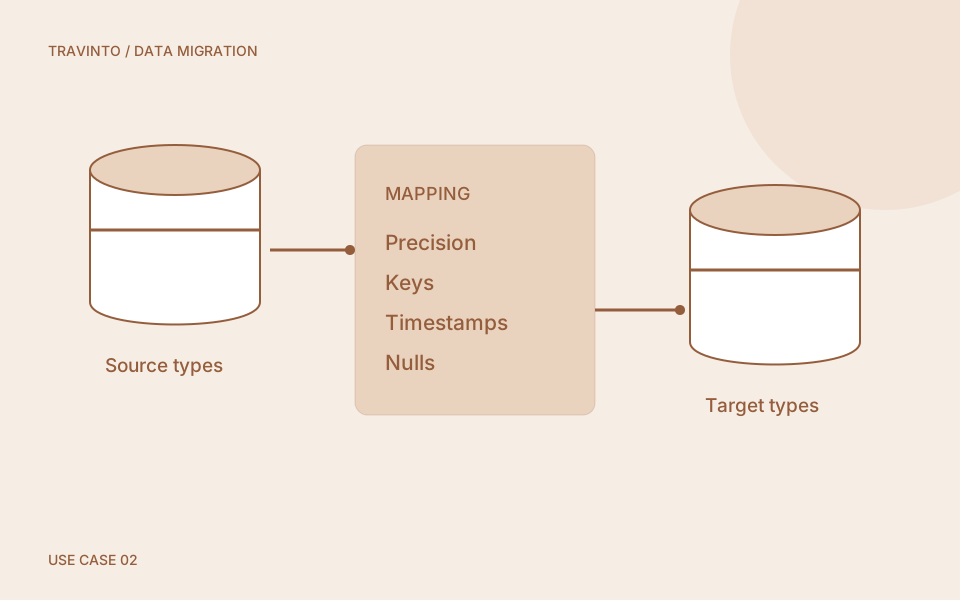
Review numeric precision, null and empty-string behavior, timestamp semantics, identity generation, sequences, keys, and constraints. Stored procedures and SQL conversion need a separate code-conversion scope; loading data does not establish application compatibility.

Warehouse & lakehouse migration

Teradata · Oracle · SQL Server → Snowflake, BigQuery, Redshift or Databricks

Analytical data, history, and reporting continuity.

Scope and validation requirements

Agree source grain, partitioning, historical retention, dimensional keys, transformations, and business reconciliation. Select bulk, staged, or incremental movement by workload. BI definitions and SQL workloads require their own acceptance checks.

Document & non-relational migration

MongoDB · Azure Cosmos DB · DynamoDB

Document, key-value, or relational-to-document redesign.

Scope and validation requirements

Assess document shape, partition and access keys, nested arrays, ordering, indexes, transaction boundaries, and consistency expectations. These are schema-design decisions, not a promise that every non-relational source and target can be paired directly.

COTS application data migration

SAP · Oracle enterprise applications · Dynamics 365 · Salesforce

Commercial off-the-shelf applications organized around business objects.

Scope and validation requirements

Migrate approved business objects through vendor-supported APIs, export/import packages, migration objects, or agreed staging interfaces. Preserve parent-child relationships, legal entities, reference data, custom fields, audit requirements, and application-level validation.

Consolidation, carve-out & archive

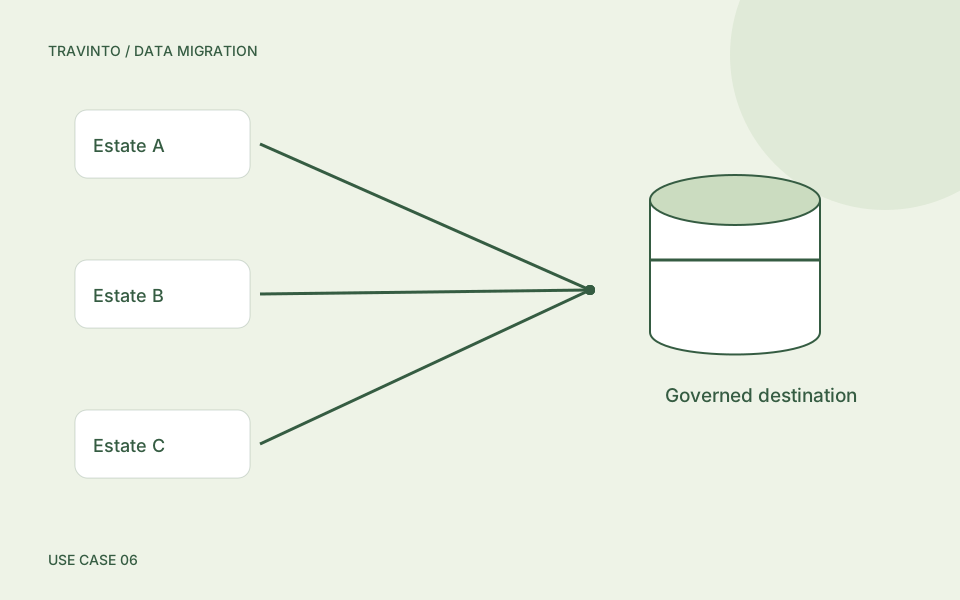
Multiple ERP or CRM estates → a governed destination

Merge, separate, or retain selected business data.

Scope and validation requirements

Define survivorship, duplicate handling, entity boundaries, retention, historical access, and evidence requirements. Agree which records move, which remain in an archive, and how users retrieve retained history after cutover.

Other discovery examples include MySQL, MariaDB, IBM Db2, Amazon RDS and Aurora, Azure SQL, and Cloud SQL. A named platform is not a released compatibility certification or a promise of every source-to-target pairing.

DATABASE & APPLICATION MIGRATION CATALOG

100 platforms.
Start with your estate.

Explore database engines, analytical platforms, and enterprise applications by name or category. Define the source, destination, versions, and business-object scope for your migration.

25Relational & distributed SQL20Document, key-value, graph & search15Warehouse & analytical platforms20ERP, finance & CRM applications20HR, service, commerce & content applications

100 of 100 platforms

  • Oracle DatabaseRelational & distributed SQL
  • Microsoft SQL ServerRelational & distributed SQL
  • PostgreSQLRelational & distributed SQL
  • MySQLRelational & distributed SQL
  • MariaDBRelational & distributed SQL
  • IBM Db2Relational & distributed SQL
  • IBM InformixRelational & distributed SQL
  • SAP HANARelational & distributed SQL
  • SAP ASERelational & distributed SQL
  • SAP SQL AnywhereRelational & distributed SQL
  • SQLiteRelational & distributed SQL
  • FirebirdRelational & distributed SQL
  • InterBaseRelational & distributed SQL
  • Progress OpenEdgeRelational & distributed SQL
  • Actian IngresRelational & distributed SQL
  • Actian ZenRelational & distributed SQL
  • Fujitsu Enterprise PostgresRelational & distributed SQL
  • EDB Postgres Advanced ServerRelational & distributed SQL
  • CockroachDBRelational & distributed SQL
  • YugabyteDBRelational & distributed SQL
  • TiDBRelational & distributed SQL
  • SingleStoreRelational & distributed SQL
  • Google Cloud SpannerRelational & distributed SQL
  • Amazon AuroraRelational & distributed SQL
  • Azure SQL DatabaseRelational & distributed SQL
  • MongoDBDocument, key-value, graph & search
  • Amazon DocumentDBDocument, key-value, graph & search
  • Azure Cosmos DBDocument, key-value, graph & search
  • Amazon DynamoDBDocument, key-value, graph & search
  • Apache CassandraDocument, key-value, graph & search
  • DataStax EnterpriseDocument, key-value, graph & search
  • ScyllaDBDocument, key-value, graph & search
  • Apache HBaseDocument, key-value, graph & search
  • Google Cloud BigtableDocument, key-value, graph & search
  • CouchbaseDocument, key-value, graph & search
  • Apache CouchDBDocument, key-value, graph & search
  • RavenDBDocument, key-value, graph & search
  • RedisDocument, key-value, graph & search
  • Amazon ElastiCacheDocument, key-value, graph & search
  • Neo4jDocument, key-value, graph & search
  • Amazon NeptuneDocument, key-value, graph & search
  • ArangoDBDocument, key-value, graph & search
  • MarkLogicDocument, key-value, graph & search
  • ElasticsearchDocument, key-value, graph & search
  • OpenSearchDocument, key-value, graph & search
  • SnowflakeWarehouse & analytical platforms
  • Google BigQueryWarehouse & analytical platforms
  • Amazon RedshiftWarehouse & analytical platforms
  • DatabricksWarehouse & analytical platforms
  • Azure Synapse AnalyticsWarehouse & analytical platforms
  • Microsoft Fabric WarehouseWarehouse & analytical platforms
  • TeradataWarehouse & analytical platforms
  • IBM NetezzaWarehouse & analytical platforms
  • VerticaWarehouse & analytical platforms
  • ClickHouseWarehouse & analytical platforms
  • GreenplumWarehouse & analytical platforms
  • Apache HiveWarehouse & analytical platforms
  • Apache ImpalaWarehouse & analytical platforms
  • Apache DruidWarehouse & analytical platforms
  • SAP IQWarehouse & analytical platforms
  • SAP ECCERP, finance & CRM applications
  • SAP S/4HANAERP, finance & CRM applications
  • SAP Business OneERP, finance & CRM applications
  • SAP Business ByDesignERP, finance & CRM applications
  • Oracle E-Business SuiteERP, finance & CRM applications
  • Oracle Fusion Cloud ERPERP, finance & CRM applications
  • Oracle PeopleSoftERP, finance & CRM applications
  • Oracle JD Edwards EnterpriseOneERP, finance & CRM applications
  • Oracle NetSuiteERP, finance & CRM applications
  • Microsoft Dynamics 365 FinanceERP, finance & CRM applications
  • Microsoft Dynamics 365 Supply Chain ManagementERP, finance & CRM applications
  • Microsoft Dynamics 365 Business CentralERP, finance & CRM applications
  • Microsoft Dynamics 365 SalesERP, finance & CRM applications
  • SalesforceERP, finance & CRM applications
  • HubSpot CRMERP, finance & CRM applications
  • Zoho CRMERP, finance & CRM applications
  • Infor CloudSuiteERP, finance & CRM applications
  • Sage X3ERP, finance & CRM applications
  • IFS CloudERP, finance & CRM applications
  • Epicor KineticERP, finance & CRM applications
  • WorkdayHR, service, commerce & content applications
  • Oracle Fusion Cloud HCMHR, service, commerce & content applications
  • SAP SuccessFactorsHR, service, commerce & content applications
  • UKG ProHR, service, commerce & content applications
  • ADP Workforce NowHR, service, commerce & content applications
  • ServiceNowHR, service, commerce & content applications
  • BMC Helix ITSMHR, service, commerce & content applications
  • JiraHR, service, commerce & content applications
  • ConfluenceHR, service, commerce & content applications
  • ZendeskHR, service, commerce & content applications
  • FreshserviceHR, service, commerce & content applications
  • ShopifyHR, service, commerce & content applications
  • Adobe CommerceHR, service, commerce & content applications
  • Adobe Experience ManagerHR, service, commerce & content applications
  • Adobe Marketo EngageHR, service, commerce & content applications
  • Salesforce Marketing CloudHR, service, commerce & content applications
  • Microsoft SharePointHR, service, commerce & content applications
  • OpenText Content ManagementHR, service, commerce & content applications
  • IBM FileNet Content ManagerHR, service, commerce & content applications
  • Docusign eSignatureHR, service, commerce & content applications

Platform names identify migration assessment coverage, not certified connector availability or every possible source-to-target pairing. Versions, supported interfaces, licenses, object coverage, and execution capabilities are confirmed for the selected route.

Migration access and validation by platform category

Relational & distributed SQL

Review focus: Schemas, keys, types, stored logic, permissions, and history.

Assess engine-native exports, approved SQL access, or compatible extraction interfaces. Confirm versions, drivers, datatype behavior, change capture, and target loading separately.

Document, key-value, graph & search

Review focus: Document shapes, partition keys, relationships, indexes, and consistency.

Assess vendor export, backup, scan, or API interfaces for the selected product. Documents, graph edges, cache state, and search indexes require different migration semantics; rebuilding an index may be preferable to copying it.

Warehouse & analytical platforms

Review focus: Tables, partitions, historical grain, files, and reporting parity.

Assess permitted bulk exports, staged files, and destination loading interfaces. Preserve partition meaning, historical versions, reference data, and reconciliation. Query conversion, orchestration, and BI migration are separate workstreams.

ERP, finance & CRM applications

Review focus: Business objects, legal entities, reference data, and transaction dependencies.

Assess application-approved migration objects, import/export packages, staging interfaces, or licensed APIs. Respect load sequencing and application validation; direct writes to application database tables are not assumed to be supported.

HR, service, commerce & content applications

Review focus: Application records, documents, permissions, attachments, and retention.

Assess permitted APIs, migration packages, and export/import mechanisms per application. Review tenant boundaries, API limits, ownership, attachment transfer, sensitive records, retention, and destination-side validation.

Discuss your source and target platforms

COTS / COMMERCIAL OFF-THE-SHELF APPLICATIONS

Migrate business objects.
Respect application rules.

Application migration includes meaning, dependencies, ownership, and validation. A customer account or purchase order is more than a collection of database rows.

01SAP ECC & SAP S/4HANAExplore scope +

Example object scope: Business partners, materials, finance and open transaction scope.

Assess available migration objects and the applicable staging or transfer approach for the chosen release. Validate organizational mappings, custom fields, open-item dependencies, and business-owner sign-off.

02Oracle E-Business Suite & Oracle Fusion applicationsExplore scope +

Example object scope: Supplier, customer, finance, procurement and reference-data scope.

Agree the product module, supported extraction and import interface, business keys, organization mappings, and application validations. Do not treat unrestricted writes to application tables as an approved migration path.

03Microsoft Dynamics 365Explore scope +

Example object scope: Finance, operations, customer and business-entity scope.

Use the applicable data entities and import/export packages for the selected application. Review entity sequencing, legal entities, lookup dependencies, staging errors, and business validation.

04SalesforceExplore scope +

Example object scope: Accounts, contacts, opportunities and selected custom objects.

Assess object access, relationships, external IDs, ownership, duplicate policies, and bulk API limits. Plan ordering and error handling, then reconcile accepted and rejected records.

05ServiceNow & WorkdayExplore scope +

Example object scope: Approved service-management or workforce business objects.

Confirm licensed access, application-specific APIs or import mechanisms, reference relationships, sensitive-field handling, and retention. Supported objects, versions, and integration permissions need product-specific assessment.

Application acceptance remains essential

Reconcile business objects and their relationships after vendor validation. Agree supported interfaces, licenses, API limits, attachments, customizations, and historical access. Live COTS integration is not provided by this website.

CANONICAL DATA MODEL / SHARED BUSINESS MEANING

Map once to meaning.
Adapt deliberately to each target.

A canonical data model is a versioned business contract between source-specific and target-specific mappings. Use it to align identities, relationships, history, and reference values across databases and COTS applications.

CANONICAL MIGRATION ARCHITECTURE
01 / SOURCES

Source estates

Database records
ERP business objects
CRM exports or APIs

02 / INTERPRET

Source adapters

Extract permitted inputs
Map fields and codes
Resolve identity exceptions

03 / BUSINESS CONTRACT

Canonical model

Entities & relationships
Keys, history & reference data
Ownership & provenance

04 / ADAPT

Target adapters

Apply destination mappings
Enforce target requirements
Use approved load interfaces

05 / ACCEPT

Target systems

Database or data platform
COTS business objects
Reconciliation & owner review

ACROSS THE PATH: versioned mappings · quality gates · access controls · lineage · exceptions · acceptance evidence
Party & roles

A person or organization with effective-dated customer, supplier, or partner roles. Preserve source identity and role context.

Account & relationships

Account identity, type, ownership, and party-to-account roles. Agree cardinality and ownership rules for the domain.

Product & service

Versioned product or service identity, classification, attributes, and unit definitions. Preserve applicable catalog context.

Organization & location

Legal entity, business unit, site, and location identifiers. Keep organizational scope distinct from physical location.

Transaction & lines

Document or event identity, line items, party and product links, amounts, currency, and business-effective dates.

Reference data & provenance

Approved code sets, units, currency, source-record references, model version, mapping version, and migration evidence.

WORKED EXAMPLE / CUSTOMER & BUSINESS PARTNER

Two source identifiers.
One governed identity decision.

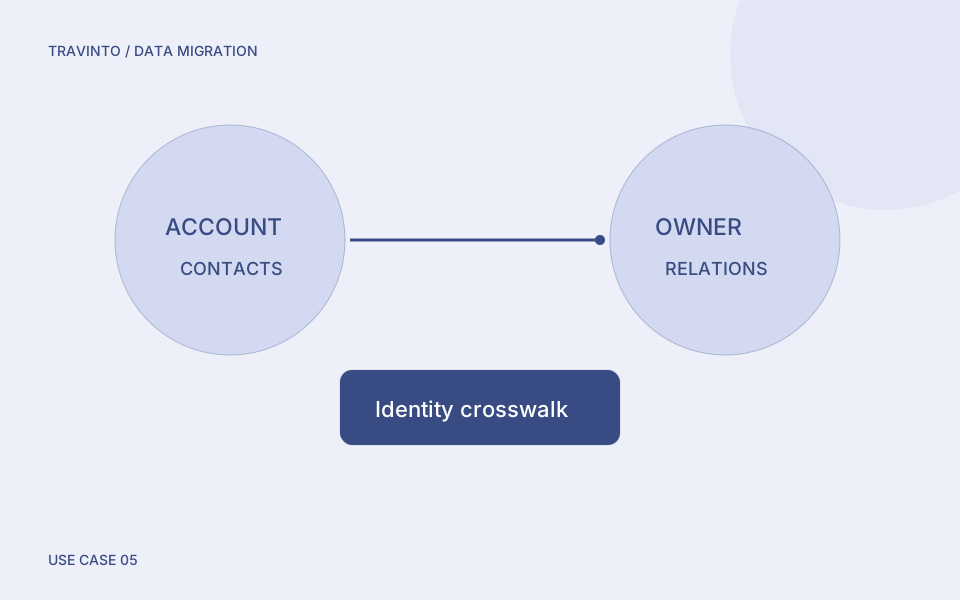
A CRM extract contains customer 1042; an ERP extract contains business partner A017. These are separate source identities until an approved crosswalk or reviewed match establishes their relationship. If they represent the same party, the canonical record retains both identifiers under a governed party key.

Keep customer and supplier roles, legal-entity context, status mappings, and effective dates explicit. A similar name alone is not sufficient evidence to merge two records.

DETERMINISTIC MAPPING

Approved rules establish the contract.

Version field mappings, data types, reference-code translations, key crosswalks, relationship constraints, and effective-date rules. Validate source-to-canonical and canonical-to-target outputs separately, then reconcile the complete path.

AGENTIC ASSISTANCE

Proposals stay reviewable.

Agents may suggest entity alignments, explain source semantics, identify missing mappings, and prepare test cases. Record supporting evidence and uncertainty. Domain stewards accept or reject proposals before they become executable rules.

Model governance, deployment, and when to use this pattern

Version and ownership: assign a domain owner; publish entity definitions, keys, code sets, compatibility rules, and acceptance examples. Record source, canonical-model, mapping, and target-adapter versions with each migration run.

History and change: define effective dates, source updates, deletes, corrections, schema evolution, and consumer compatibility. Retain traceable evidence from source record to accepted target object.

Deployment: canonical contracts can guide mapping design without requiring a central runtime database. Any staging store, transformation worker, metadata registry, or agent endpoint follows the agreed on-premises, cloud, or hybrid placement and access policy.

Use selectively: shared models are useful for consolidation, multiple targets, repeated migrations, and common business definitions. A single bounded source-to-target move may need only direct mappings. COTS destination interfaces and application validations still apply.

This is a canonical modeling approach for scoping X2X Data Migrator. A packaged universal domain model or prebuilt certified COTS mapping library is not implied.

TOOL WORKFLOW & FEATURE SCOPE

From discovery
to cutover evidence.

Define one governed migration plan across source assessment, mapping, movement, validation, exceptions, and operating handover. Confirm the implementation scope and product availability with Travinto.

01Discover & profile

Inventory permitted schemas and datasets; assess keys, volume, completeness, sensitive fields, and dependencies. Output: a source assessment and migration backlog.

02Map schemas & business objects

Define entity identity, field and type mappings, reference-code translation, history, units, time zones, and dependencies. Agent assistance can propose mappings; owners approve the rules.

03Prepare & transform

Specify cleansing, standardization, deduplication, masking, referential ordering, and reject handling. Keep transformation rules versioned and traceable to acceptance examples.

04Move in controlled waves

Plan bulk loads, staged files, approved API imports, incremental extracts, or CDC where the engine and connector permit it. Configure checkpoints, retry limits, throttling, and safe replay.

05Validate & reconcile

Compare records, keys, relationships, aggregates, and business measures across agreed snapshots or time windows. Classify expected differences and retain failed-check evidence.

06Manage exceptions

Maintain issue ownership, failed records, mapping ambiguities, rerun decisions, and approved exceptions. Agents can summarize evidence and propose investigation steps without accepting their own output.

07Rehearse cutover & recovery

Define freeze or change-capture windows, application dependencies, final reconciliation, go/no-go criteria, fallback behavior, and named decision owners. Downtime targets require rehearsal.

08Operate & audit

Scope run status, logs, access controls, secret references, change history, monitoring, and evidence retention. Agree product packaging and integrations before treating these as deployed capabilities.

HOW THE MIGRATION WORKS
  1. Assess sources
  2. Approve mappings
  3. Rehearse a wave
  4. Load & track changes
  5. Reconcile exceptions
  6. Approve cutover

Agents propose and investigate. Approved jobs execute within defined permissions. Independent checks and accountable owners determine acceptance.

DEPLOYMENT & INSTALLATION PLANNING

Your environment.
An explicit placement decision.

On-premises, cloud, and hybrid are deployment patterns to validate. Decide separately where the control services, migration workers, staging data, evidence store, and optional model inference will run.

Customer-controlled infrastructure

On-premises

Place migration workers, staging, and—where required—the control services and evidence store inside the private environment.

Installation and operating requirements

Assess VM or container packaging, supported operating systems, network access, patching, backup, and capacity. If agentic assistance is required, agree an approved private or local model endpoint.

Customer cloud account or subscription

Cloud

Place control services and workers in a scoped AWS, Microsoft Azure, or Google Cloud environment, with private connectivity where appropriate.

Installation and operating requirements

Agree cloud services, identity, secret management, regions, staging storage, encryption, egress, service quotas, and operating ownership. Cloud availability and packaging require confirmation.

Private workers with coordinated control

Hybrid

Keep source access and selected processing near on-premises systems while coordinating migration to an approved cloud or remote target.

Installation and operating requirements

Define which payloads, metadata, logs, and prompts cross each boundary. Assess firewall rules, private network links, bandwidth, latency, retries, and disconnected-operation requirements.

On-premises ↔ cloud · cloud ↔ cloud

Across environments

Scope source and destination independently: on-premises to on-premises, on-premises to cloud, cloud to on-premises, or cloud to cloud.

Installation and operating requirements

Agree routing, data residency, destination interfaces, execution identity, staging location, and reconciliation access for the selected route. A route describes an architecture option, not certified connector coverage.

Deployment components to agree

Control servicesPlans, schedules, configuration versions, identities, and approval records.
Migration workersSource extraction and approved destination interfaces, placed by connectivity and data-boundary needs.
Staging & evidenceEncrypted staging, retention, reconciliation access, backup, deletion, and audit ownership.
Optional agent runtimeApproved model endpoint, permitted metadata or record context, prompt logging rules, and non-agent fallback.
Security & operationsLeast-privilege identities, secret-manager integration, access review, private networking, monitoring, recovery, and patching.

A downloadable installer, certified infrastructure matrix, or managed SaaS service is not announced here. Packaging, infrastructure sizing, support model, residency controls, and deployment responsibility must be confirmed before procurement.

TWO APPROACHES / ONE ACCEPTANCE STANDARD

Rules for repeatability.
Agents for assisted reasoning.

Select the approach by task. Known transformations and policy checks suit explicit rules; incomplete context and complex exceptions may benefit from agent assistance.

RULES & CONTROLLED EXECUTION

Deterministic solution

  1. Execute approved schema mappings, type conversions, extraction windows, and load sequences.
  2. Track checkpoints, watermarks, duplicates, rejects, and replay boundaries using explicit rules.
  3. Compare source and target records, aggregates, and history against agreed keys and tolerances.

CONTEXT & REVIEWABLE PROPOSALS

Agentic solution

  1. Profile source metadata and propose candidate mappings with confidence and supporting context.
  2. Investigate unexpected variances and suggest whether timing, identity, or transformation rules need review.
  3. Prepare migration-wave and exception-resolution proposals for accountable owners.
Decision and execution boundary

An agent may propose a mapping or investigate a difference. Approved transfer jobs and comparison rules establish execution behavior; data owners accept the resulting evidence.

From approved inputs
to an accepted outcome.

X2X Data Migrator / shared execution model
01

Approved context

Versioned inputs, identity, scope

02

Rules or agent assistance

Explicit mappings or reviewed proposals

03

Independent checks

Tests, reconciliation, exception evidence

04

Accountable decision

Accept, revise, reject, or escalate

Use representative cases to establish an acceptance baseline. Record input versions, rule or model configuration, failed checks, reviewer decisions, and recovery requirements.

X2X DATA MIGRATOR / 10 USE CASES

Find your requirement.
Understand the work.

Explore ten scenarios specific to X2X Data Migrator. Explore a case-study card to see the business challenge, deterministic work, agentic assistance, and acceptance evidence to scope for your estate.

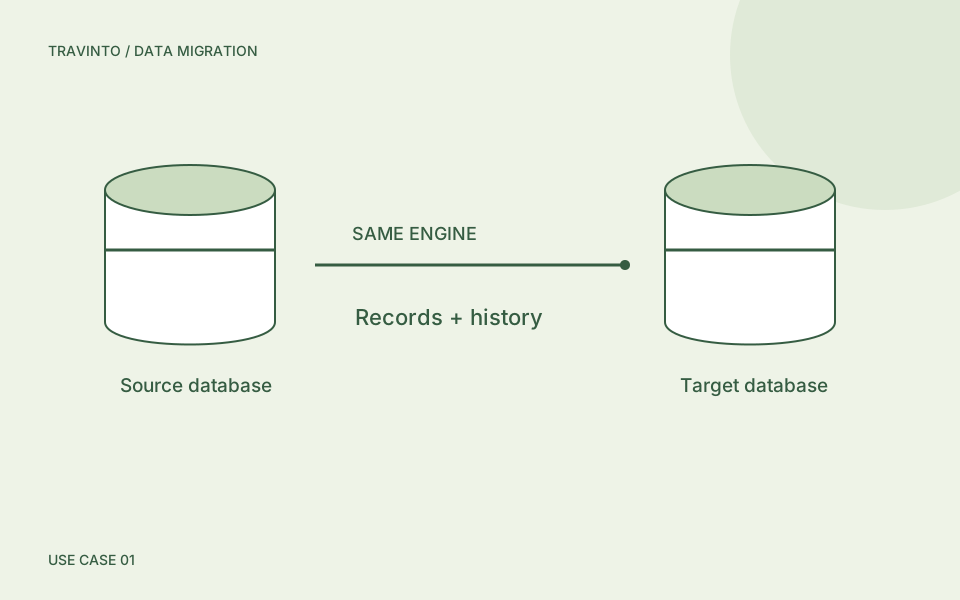
Same-engine database relocation: A database is moving to new infrastructure or a managed environment without changing the logical engine family.01DATABASE RELOCATIONIndustryHealthcareExample marketUnited StatesSame-engine database relocationA database is moving to new infrastructure or a managed environment without changing the logical engine family.Explore case study

DELIVERY APPROACH & ACCEPTANCE

Deterministic work
Execute agreed exports, loads, checksums or comparisons, and permission checks for the selected versions.
Agentic assistance
Summarize discovery gaps and propose a migration sequence from dependencies and constraints.
Acceptance evidence
Reconcile records and history; verify extensions, collation, roles, jobs, connection changes, and recovery.
Discuss this use case ↗
Cross-engine transactional migration: A source and target database represent types, keys, timestamps, and transactions differently.02ENGINE CHANGEIndustryBanking & financial servicesExample marketUnited KingdomCross-engine transactional migrationA source and target database represent types, keys, timestamps, and transactions differently.Explore case study

DELIVERY APPROACH & ACCEPTANCE

Deterministic work
Apply approved field, type, key, and reference mappings with explicit rejection rules.
Agentic assistance
Propose mappings for ambiguous values and investigate source-to-target differences.
Acceptance evidence
Validate precision, nulls, generated keys, relationships, deletes, and application expectations.
Discuss this use case ↗
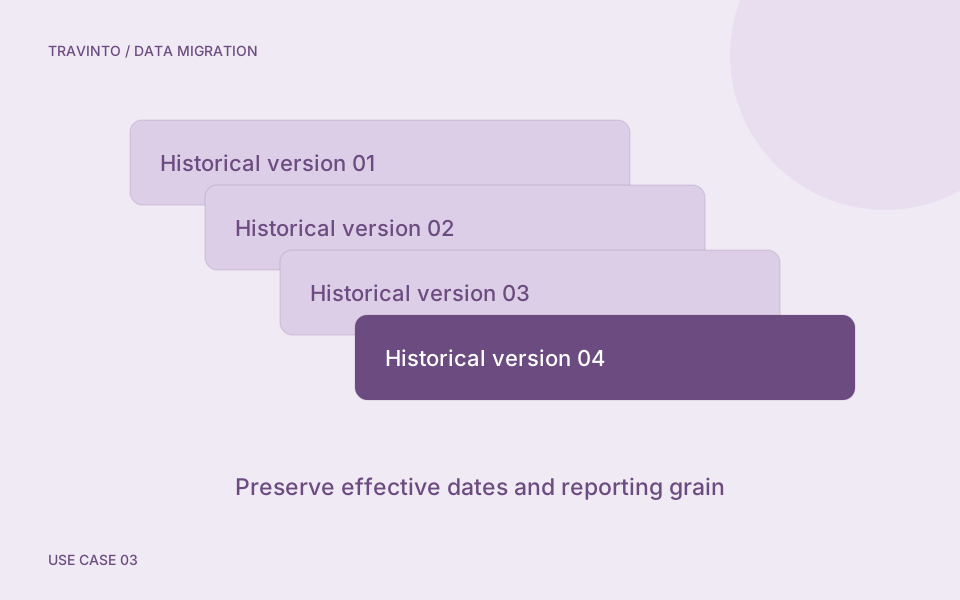
Historical warehouse movement: A data platform transition must preserve historical reporting grain and slowly changing records.03ANALYTICAL HISTORYIndustryRetail & commerceExample marketGermanyHistorical warehouse movementA data platform transition must preserve historical reporting grain and slowly changing records.Explore case study

DELIVERY APPROACH & ACCEPTANCE

Deterministic work
Move approved partitions and historical versions using fixed mappings and comparison windows.
Agentic assistance
Identify suspicious gaps, inconsistent dimensions, or unclear historical status meanings.
Acceptance evidence
Compare effective-date joins, period totals, late records, and retained history with domain owners.
Discuss this use case ↗
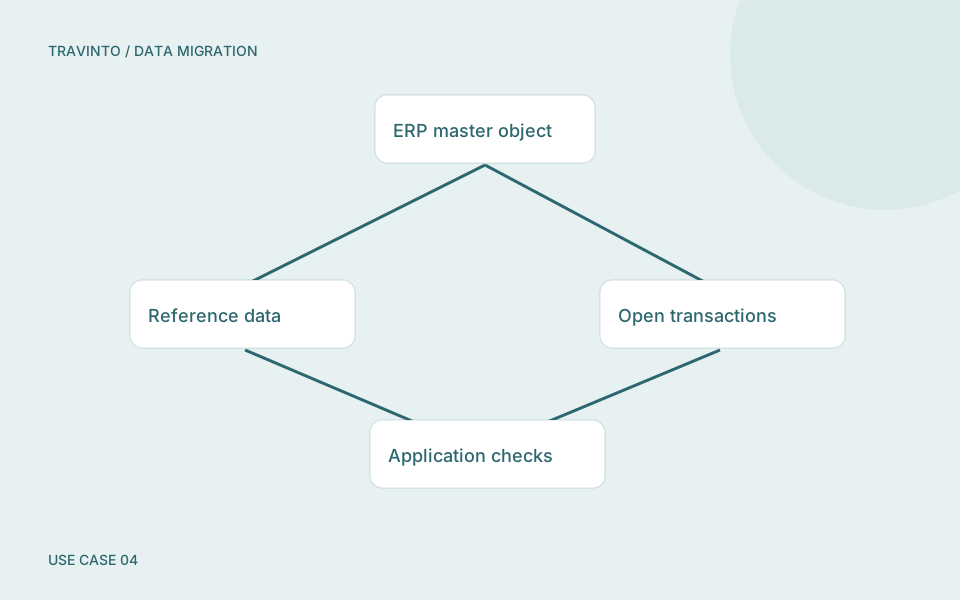
ERP business-object migration: An ERP transition requires master records and open transactions loaded in an approved sequence.04COTS / ERPIndustryManufacturingExample marketIndiaERP business-object migrationAn ERP transition requires master records and open transactions loaded in an approved sequence.Explore case study

DELIVERY APPROACH & ACCEPTANCE

Deterministic work
Prepare validated packages or payloads for the applicable vendor-supported migration interfaces.
Agentic assistance
Propose object mappings, organizational crosswalks, and exception investigation steps.
Acceptance evidence
Check parent-child dependencies, legal entities, reference values, rejected objects, and application validation.
Discuss this use case ↗
CRM customer and relationship migration: Customer accounts, contacts, ownership, and related records must retain their business relationships.05COTS / CRMIndustryProfessional servicesExample marketUnited Arab EmiratesCRM customer and relationship migrationCustomer accounts, contacts, ownership, and related records must retain their business relationships.Explore case study

DELIVERY APPROACH & ACCEPTANCE

Deterministic work
Apply approved identity crosswalks, relationship ordering, field rules, and accepted import mechanisms.
Agentic assistance
Suggest match candidates and explain conflicts without merging records autonomously.
Acceptance evidence
Reconcile accepted and rejected records, owners, relationships, consent fields, and custom-object dependencies.
Discuss this use case ↗
Post-acquisition estate consolidation: Multiple source systems need to contribute to an agreed destination without losing provenance.06CONSOLIDATIONIndustryInsuranceExample marketUnited StatesPost-acquisition estate consolidationMultiple source systems need to contribute to an agreed destination without losing provenance.Explore case study

DELIVERY APPROACH & ACCEPTANCE

Deterministic work
Apply approved canonical mappings, survivorship rules, source namespaces, and reconciliation controls.
Agentic assistance
Highlight competing definitions and suggest resolution options for data stewards.
Acceptance evidence
Retain source identifiers and history; review duplicate decisions, disputed values, and destination ownership.
Discuss this use case ↗
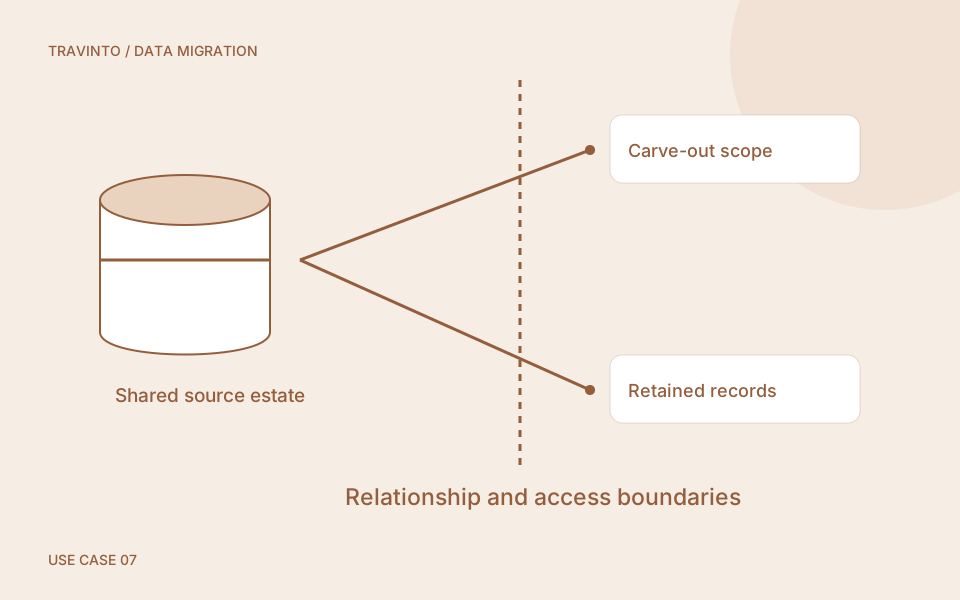
Business-unit carve-out: A divestment requires a defined subset of records to move while protecting retained information.07SEPARATIONIndustryPublic sectorExample marketAustraliaBusiness-unit carve-outA divestment requires a defined subset of records to move while protecting retained information.Explore case study

DELIVERY APPROACH & ACCEPTANCE

Deterministic work
Select records using approved organizational, relationship, and time-boundary rules.
Agentic assistance
Identify linked-record dependencies and explain uncertain inclusion decisions.
Acceptance evidence
Prove subset completeness, excluded-data protection, referential integrity, and retained-source access.
Discuss this use case ↗
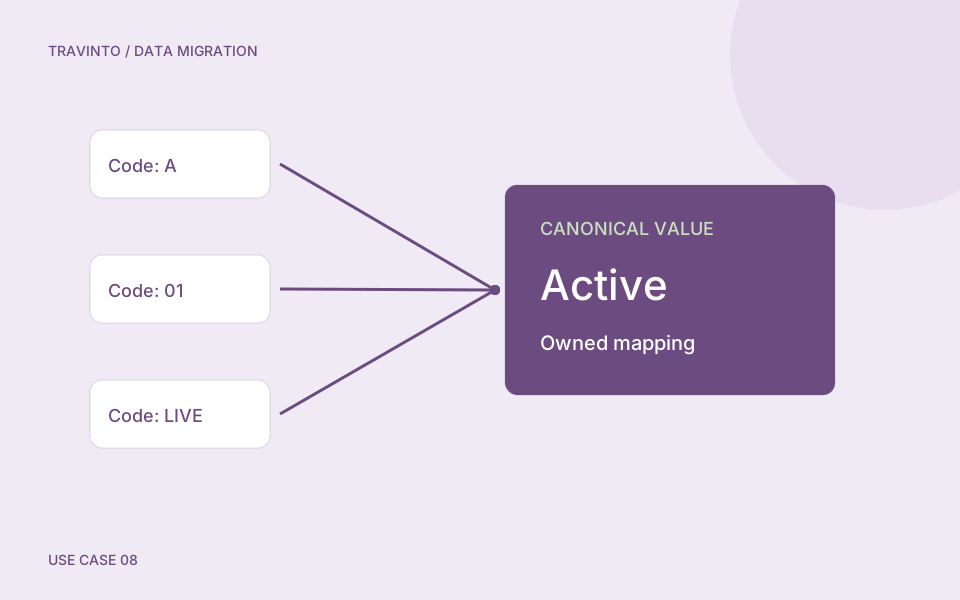
Master and reference-data harmonization: Sources use different product, supplier, location, status, currency, or unit codes.08SHARED DEFINITIONSIndustryLogisticsExample marketSingaporeMaster and reference-data harmonizationSources use different product, supplier, location, status, currency, or unit codes.Explore case study

DELIVERY APPROACH & ACCEPTANCE

Deterministic work
Apply governed code crosswalks, canonical identifiers, compatibility checks, and effective-date rules.
Agentic assistance
Propose alignments and identify unmapped or conflicting meanings for owner review.
Acceptance evidence
Validate mapping coverage, unknown-code behavior, relationships, historical applicability, and stewardship sign-off.
Discuss this use case ↗
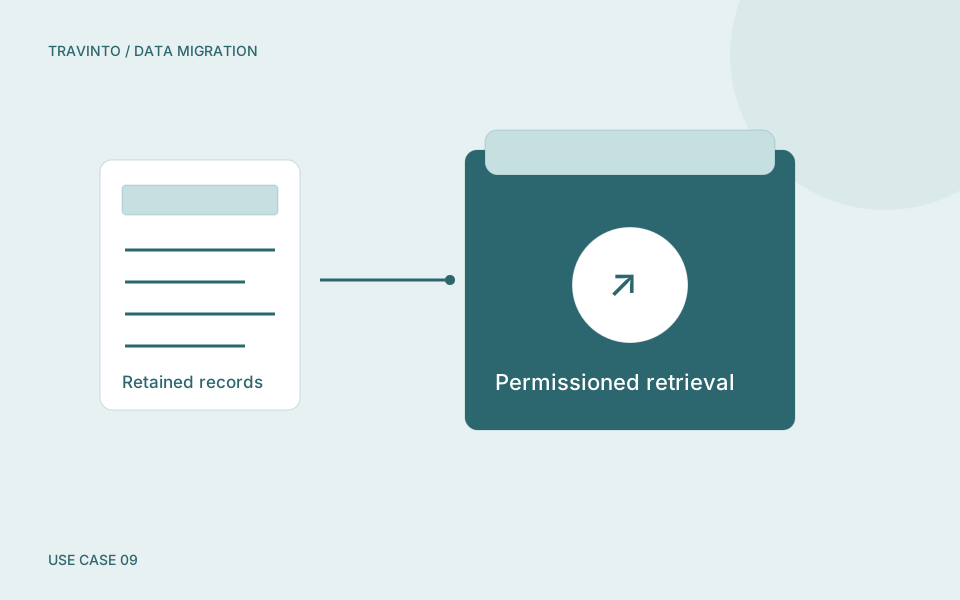
Archive and retention migration: An application is retiring but selected records must remain retrievable under agreed retention rules.09HISTORICAL ACCESSIndustryEnergy & utilitiesExample marketCanadaArchive and retention migrationAn application is retiring but selected records must remain retrievable under agreed retention rules.Explore case study

DELIVERY APPROACH & ACCEPTANCE

Deterministic work
Transfer approved records and attachments with integrity checks, classification, and retention metadata.
Agentic assistance
Help classify unresolved dependencies and prepare retrieval-test scenarios.
Acceptance evidence
Demonstrate record retrieval, provenance, permissions, attachment integrity, retention, and deletion responsibilities.
Discuss this use case ↗
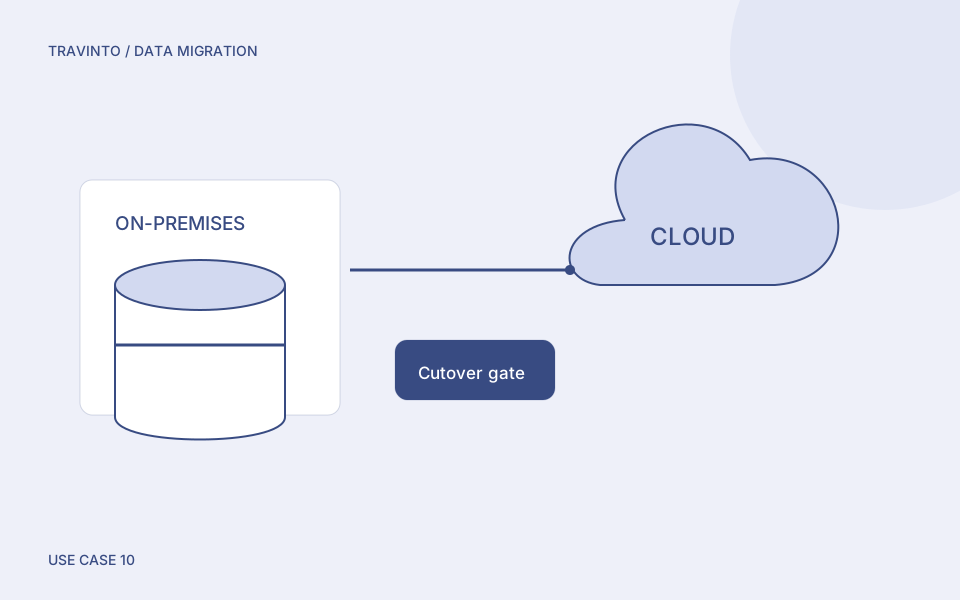
Hybrid migration with controlled cutover: On-premises and cloud systems need a staged transition while business changes continue.10TRANSITION OPERATIONSIndustryTelecommunicationsExample marketNetherlandsHybrid migration with controlled cutoverOn-premises and cloud systems need a staged transition while business changes continue.Explore case study

DELIVERY APPROACH & ACCEPTANCE

Deterministic work
Run approved initial loads and permitted incremental or CDC paths with checkpoints and safe replay rules.
Agentic assistance
Investigate lag or variance and propose bounded recovery actions for operators.
Acceptance evidence
Rehearse change windows, final reconciliation, go/no-go evidence, rollback, and operational handover.
Discuss this use case ↗

Industry and example-market labels provide scenario context. They do not identify actual customers or customer locations. These use cases describe requirements and design approaches, not completed customer projects. Source and target compatibility, available features, and implementation scope are confirmed during assessment.

PRODUCT QUESTIONS

Plan with clarity.

How is source-to-target data accuracy assessed?

Agree comparison keys, effective dates, transformation rules, and tolerances first. Then review record completeness, aggregates, business metrics, and exception evidence. Matching row counts alone does not establish accuracy.

What information is needed to assess product fit?

Start with a bounded workflow, authorized source examples, platform versions, business rules, and named reviewers. Agree the expected evidence and acceptance criteria before implementation.

How can we discuss availability and implementation?

Contact Travinto with the source and target landscape, scope, and operating constraints. Availability, integrations, execution capabilities, delivery responsibilities, and commercial terms require confirmation.

Which databases and COTS applications can we assess?

Examples include Oracle Database, SQL Server, PostgreSQL, MySQL, Db2, analytical platforms, and business applications such as SAP, Oracle enterprise applications, Dynamics 365, and Salesforce. These names describe assessment scenarios. Confirm source and target versions, licensed interfaces, object coverage, and connector availability before selecting a migration route.

Can X2X Data Migrator be installed on-premises, in the cloud, or in a hybrid environment?

On-premises, customer-cloud, and hybrid placements are deployment patterns to scope with Travinto. The location of control services, workers, staging, evidence, and model inference is agreed separately. Installer availability, supported runtimes, infrastructure sizing, network requirements, and operating responsibilities require confirmation.

Does COTS migration mean copying application database tables?

Not necessarily. Business-object migration should use the applicable vendor-supported interfaces and validation process. Application relationships, organizational context, customizations, and load sequencing need assessment. Direct application-table writes are not assumed to be supported.

Is agentic assistance required to run deterministic migration rules?

The execution design should allow approved rules and migration jobs to operate independently of agent-generated proposals. Agentic assistance may support mapping, investigation, and planning. Model hosting, permitted context, review policy, and fallback behavior must be agreed for the implementation.

How does a canonical data model help database and COTS migration?

A canonical model defines shared business entities, identifiers, relationships, reference values, history, and provenance between source and target mappings. It can make mappings reusable across multiple estates, while target adapters still apply destination-specific formats and application validation. Domain owners approve the model and identity rules; agent suggestions do not establish business equivalence.

Product scope and availability are confirmed during assessment. This website does not execute migrations, data pipelines, or operational actions.

Compare Travinto products